
Under Pressure: the Science Behind Canning Food
Key Takeaways
The Magic of Science: Pressure canning harmonizes physics, chemistry, and biology to turn fresh produce into shelf-stable food that stays safe as long as the jar's seal holds.
The Biological Enemy: Low-acid foods create an ideal environment for Clostridium botulinum, an anaerobic bacterium that forms heat-proof endospores and produces dangerous toxins.
Physics Under Pressure: Standard boiling water caps out at 212°F, but applying Gay-Lussac’s Law—increasing pressure within a fixed volume—forces steam up to the 240°F threshold required to kill endospores.
Acidity Limits: High-acid foods naturally stop C. botulinum growth, but inconsistent produce like tomatoes needs tested recipes or added lemon juice to guarantee safe water-bath canning.
Equipment Rules: Electric pressure cookers (like Instant Pots) cannot safely preserve low-acid food; only calibrated dial-gauge or weighted-gauge stovetop pressure canners provide reliable heat distribution.
I am a magician. And you can be, too.
Well, I can’t do real magic. I have no sleight-of-hand or cool mentalist tricks. But using a massive pressure canner on the stovetop is the closest thing I’ve come to being able to say “abra-cadabra!” or “ta da!”.
Why?
Because canning food is the harmonization of three major types of science: physics, chemistry, and biology. All three get called on at the same time to do their thing and make it so fresh food gets transformed into shelf stable nutrition, that will last as long as the seal will.
And that feels pretty magical to me.
Let’s break this down, starting with the biology.
The Biology of Pressure Canning
As mentioned in the previous blog about the primer on food preservation, certain foods must be pressure canned due to their risk of botulism. The Clostridium botulinum bacteria poses some big risks. Let’s talk a little more about C. botulinum and what makes it so… special.
First off: it’s anaerobic. This means it thrives without oxygen. Yes, you read that right. It grows and grows in the absence of oxygen.
Second: it has the ability to develop a protective spore covering, called and endospore. And that is an extremely tough outer casing that makes it boil-proof and heat-proof. Super tough stuff.
Third: if it ends up in your canned food, it’ll start eating the canned food and make botulinum toxin - that’s the stuff that causes paralysis. Most of the time we hear about it causing intentional paralysis in people’s facial muscles to stop wrinkles. But when botulinum toxin is not where you want it to be… it can be deadly.
If the C. botulinum bacteria is in your food when you put it in the pressure canner (which there are decent odds that it is), and then you remove the oxygen from that environment, poof! You’ve created the perfect environment to let it grow and make botulinum toxin. Oops.
And even if you cook the living daylights out of that food later, the bacteria still had its fun and made allll that nice botulinum toxin.
So, we have to kill the C. botulinum when we preserve the foods. And to do that, we have to bust through their defense mechanism - the endospores.
How to Destroy a C. botulinum Endospore
I know when I said that we were going to do magic with science I might have lost some of you. I think I definitely lost some of you when I said that we were going to use chemistry and physics. But it’s going to be ok - this is really cool and you’ll get it.
Although C. botulinum’s endospores are made to withstand seemingly end-of-times, we just have to get it up to 240F. I know, I know, the boiling point of water is only 212F. So, let’s use some chemistry and physics.
There’s an equation often taught in chemistry: Guy-Lussac’s Law. It essentially means that at a constant volume, pressure and temperature are related. When you increase pressure while maintaining the same volume, the temperature goes up. Here’s a picture to help describe what is going on:
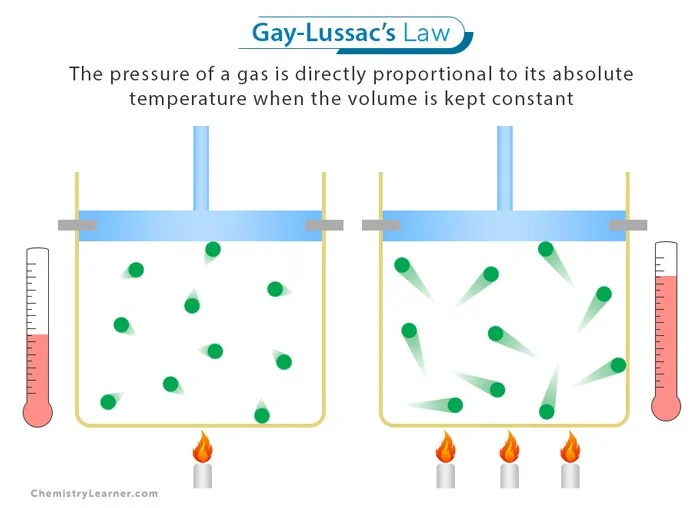
In a pressure cooker, we keep the same volume (the amount of food we’re making), we increase the pressure (we add water and then turn up the temp to make steam, which increases pressure), and therefore the temperature is going to be able to go up high enough to kill the endospores.
Why Don’t All Foods Need to be Pressure Canned?
C. botulinum might be a tough little bugger, but it does have an Achilles heel: it can’t handle acid. It won’t eat acidic foods, and therefore it won’t make the botulinum toxin. Foods have to be a minimum level of acidity though to be scary enough to fend off C. botulinum, and that level is actually pretty darn acidic.
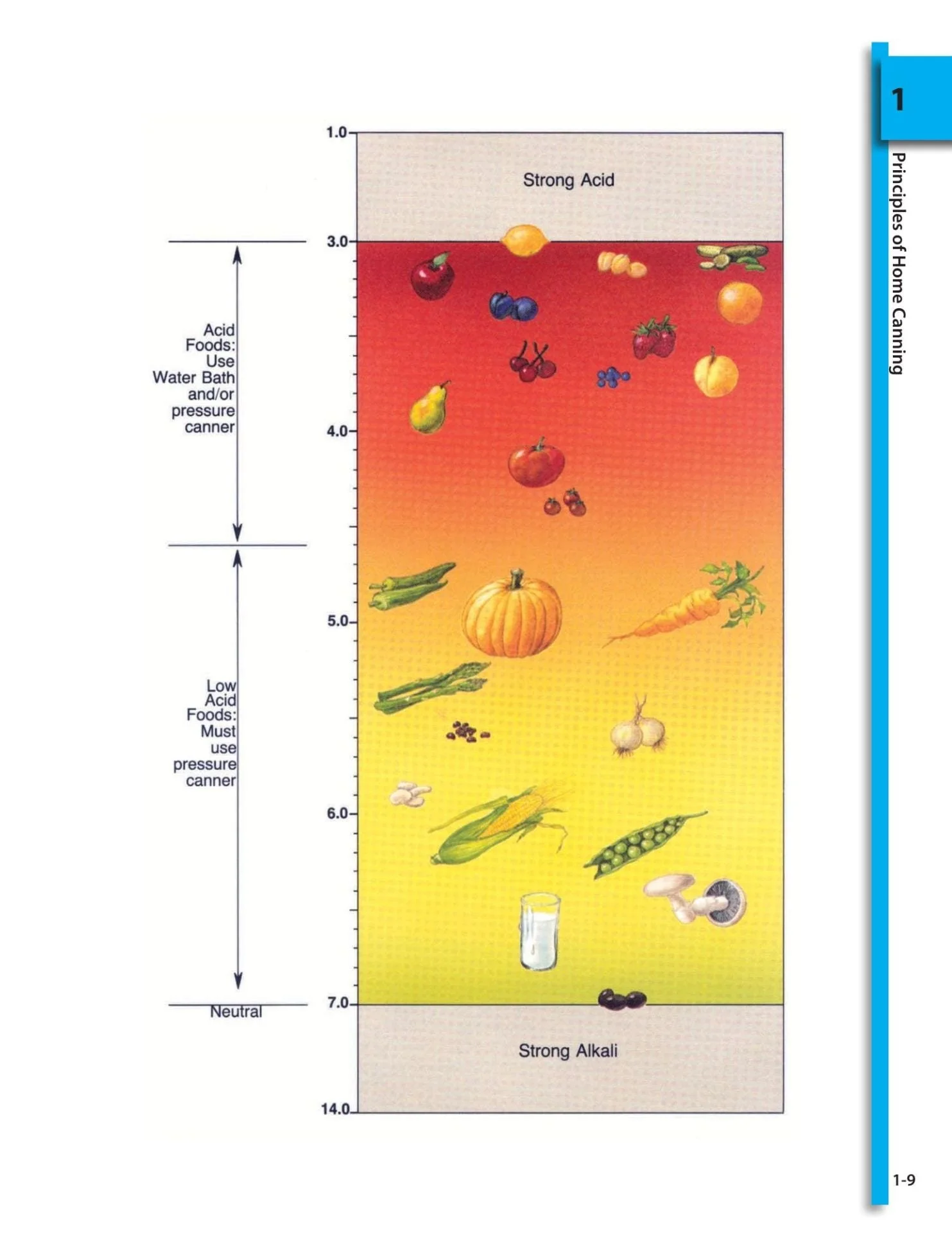
From So Easy to Preserve, a University of Georgia publication
While that is a wonderful reference document, I’m going to throw a caveat in here: it shows that tomatoes are acidic enough to fend off C. botulinum, and unfortunately we know that is actually variety-dependent.
Different tomatoes have different acidity levels, and tomatoes right on that graphic’s line. Many tomato sauce recipes actually call for adding lemon juice for increasing the acidity enough that they can be water-bathed. Again, check for a Cooperative Extension tested recipe. Don’t roll the dice on that.
One Last Safety Note…
There are many different types of pressure canners, and generally they fall into four categories:
1) Instant Pot (plug-in pressure cooker)
This is a great cooking tool. It is not made for food preservation. Do not rely on an Instant Pot or similar for canning food.
2) Dial gauge
These are pressure canners that have a dial gauge on top. Oftentimes, recipes will call for 10 lbs of pressure with a weighted gauge, or 11 lbs of pressure with a dial gauge. Dial gauges are very popular, but very finicky. They need to be tested and calibrated every year.
And, they’re fully visual - if at any point in the process, the pressure drops below 11 lbs, you have to restart your timer (and sometimes those timers are close to 2 hours).
3) Weighted gauge
These are also often called jigglers. They’re little weights that sit on the top of a pressure canner steam exhaust and jiggle, dance, twirl, etc when enough pressure is built up inside the canner to get them to move.
You can hear them, they’re easy to see from across the room. It’s nice to have something that simple to keep tabs on when you’re doing a project this long. Is it obvious that I have a favorite?
4) Hybrid (dial and weighted gauge)
Actually, these may be my favorite. They’re not that common, though. They have both a dial gauge and a weighted gauge. It’s a little overkill, sure, but this is one process where it’s nice to have peace of mind.
Frequently Asked Questions About Pressure Canning
Thanks for making it this far! For future reference, here are some FAQs to help you out:
-
Canning preserves food by using heat to destroy harmful microorganisms - such as bacteria, yeasts, and molds -that cause food to spoil. The process also inactivates enzymes that lead to food degradation. As the jars cool after being heated, a vacuum seal forms. This airtight seal prevents any new microorganisms or oxygen from entering the jar, keeping the food safe and shelf-stable for long periods.
-
The main difference is the temperature achieved during the process. Water bath canning reaches a maximum of 212°F (100°C), which is the boiling point of water. It is only safe for highly acidic foods like fruits, jams, and pickles. Pressure canning uses trapped steam to raise the pressure, and therefore raise the temperature inside the pot to 240°F–250°F (115°C–121°C). This higher temperature is absolutely necessary to safely can low-acid foods like vegetables, meats, and soups.
-
Low-acid foods - like green beans, carrots, meats, and broths - do not have enough natural acidity to prevent the growth of Clostridium botulinum, the bacteria responsible for botulism. The spores of this bacteria can survive the boiling temperatures of a water bath canner. Only the high heat achieved under pressure (240°F or higher) can reliably destroy these dangerous spores.
-
A pressure canner works based on the principles of chemistry and physics. Normally, water cannot exceed its boiling point of 212°F (100°C) in an open environment. However, by sealing the pot and trapping the steam, the pressure inside the canner increases. As atmospheric pressure increases, the temperature rises. This allows the steam to reach the 240°F (115°C) threshold necessary for killing C. botulinum spores.
-
Altitude significantly affects canning because the boiling point of water drops as elevation increases (due to lower atmospheric pressure). If you live at a higher altitude, your water bath canner will boil at a lower temperature, and your pressure canner will need more pressure to reach the required 240°F. To ensure food safety, you must adjust your canning times and pressure gauge settings based on your specific elevation.
See this link for more details on how to increase the processing time based on your elevation: https://extension.sdstate.edu/altitude-adjustments-home-canning
-
No. Most standard pressure cookers and electric multicookers (like the Instant Pot) are not designed or tested for safe pressure canning. They often cannot maintain the consistent, precise pressure and temperature required to safely process low-acid foods. Always use a dedicated, USDA-approved stovetop pressure canner for safe home food preservation.
