
So you have doctor’s clearance to use an electrolyte supplement: now what?
There seem to be no shortage of electrolyte powders out there, all with different attributes.
Some are really accessible and widely distributed (Liquid IV, LMNT, Nuun) while others are a bit more… niche. And then there are people like me who want to mix their own at home.
What is in these mixes anyways?
Generally, your electrolyte mix is going to have several basic ingredients:
Electrolytes (duh) - this may look like sodium, potassium, magnesium, and trace minerals, with an attached ionic buddy (like chloride, citrate, malate, oxide, etc). The charged particles do matter, particularly with magnesium, but more on that later.
Flavor - often a fruity option, like lemonade, passionfruit, grape, “fruit punch”, or similar. But sometimes you get lucky and your niece will gift you a hot chocolate option for Christmas.
Sweetener - plain electrolytes taste terrible. Just the straight up mix of them brings to mind essence of bitter, rotten seawater. To me, at least. So sweetener is a non-negotiable flavor balancer, even if it’s just a little. Common options seen in mixes are sugar, stevia, aspartame, monkfruit, sugar alcohols like xylitol or erythritol, acesulfame potassium (aka Ace K), and many more.
How do I evaluate which one to buy?
I have several primary criteria I use when selecting an electrolyte supplement:
1. Does it have a comparable minimum amount of electrolytes that I know I benefit from when I need the electrolytes (i.e. desert hiking)?
The amount of electrolytes one needs during an event is based on so many factors, and we have a very limited selection of testing tools at this point to identify what someone might need. Gatorade makes a sweat patch that measures sodium loss during an activity, so that’s a good start. Exercise watches aim to estimate sodium loss. Several other sensor (expensive) options exist, like the Nix, FloBio, and hDrop.
But if you’re more of a guess-and-check kind of athlete, you can also just try different electrolyte options for yourself and see which one is working the best for you.
2. What kind of sweetener do I want/need for this activity?
First I ask: do I need fast acting carbohydrates for this activity? Most often the answer is no - it’s a walk or a short hike. So for sugar-free mixes, we’re presented with a few options.
With the current data out there, I am partial to stevia as a no-sugar sweetener. But, everyone’s taste is different! Perhaps you’re more into monkfruit. I do have a hard time recommending the artificial sweeteners, and I can’t in good conscious recommend xylitol or erythritol after the research connecting them to heart disease and stroke.
Now let’s say I do need fast acting carbohydrates for the activity - it’s something where I’ll be out there for several hours, it’s really hot, and I need glucose to help enhance the body’s absorption of the electrolytes. That’s a perfect use case for an electrolyte blend that uses sugar as its sweetener.
3. Do I care about the convenience/ease of packaging?
Electrolyte mixes come in all variety of packaging: little tablets, powders in packets, powders in tubs, powders in big bulk bags. And if you do need sugar in your electrolytes, be prepared to be toting around a lot more volume. Sugar takes up much more physical space than the non-sugar sweeteners.
I personally like the convenience of the little tablets in a tube. There’s less trash, 10 tablets fit in a purse very easily this way, and they fizzle themselves into the water easily.
4. Can I make the electrolyte powder myself?
This is the question I asked myself a year ago: why am I spending money on electrolytes when I look at the ingredients label, can do some basic math, and make my own powdered mix? So, that’s exactly what I did.
To start, I had been testing different off-the-shelf electrolyte mixes in my own desert activities for several years, and I had a couple of winners. These were products that kept me safe and having a good time through multiple Grand Canyon Rim-to-Rim hikes, backpacking through Sedona in August, and a desert ultramarathon. They were trustworthy and thanks to their nutrition facts labels, I knew the milligram amounts of each electrolyte.
I started looking at sourcing the ingredients and was initially daunted. These are chemical sounding names, and I needed to make sure they were food safe. But then I realized.
Sodium chloride is table salt.
Potassium chloride is the salt substitute Nu salt.
And table sugar already has the best glucose/fructose ratio for endurance activities. And I can buy powdered stevia easily for when I don’t want sugar.
The last piece of the puzzle was magnesium, and choosing which magnesium salt I wanted to trial.
Magnesium’s ionic buddy options
Mg+ needs another charged particle to see it through to the body. Once the compound is in water, it’ll dissolve into its two ions: Mg+ and its charged counterpart. Magnesium has a number of common options:
chloride - decent bioavailability
oxide - poor absorption, most likely to cause digestive issues (re: diarrhea)
malate - popular in the athletic community, but founded on very few studies (outside of rats and theoretical biochemical pathways)
I took a chance on magnesium malate.
And it was fine. I tolerated it just fine. My athletic performance was fine. But there is just much more robust research on magnesium citrate, and the next time I need to reorder electrolytes, I’ll probably trial magnesium citrate.
My electrolyte blend recipe
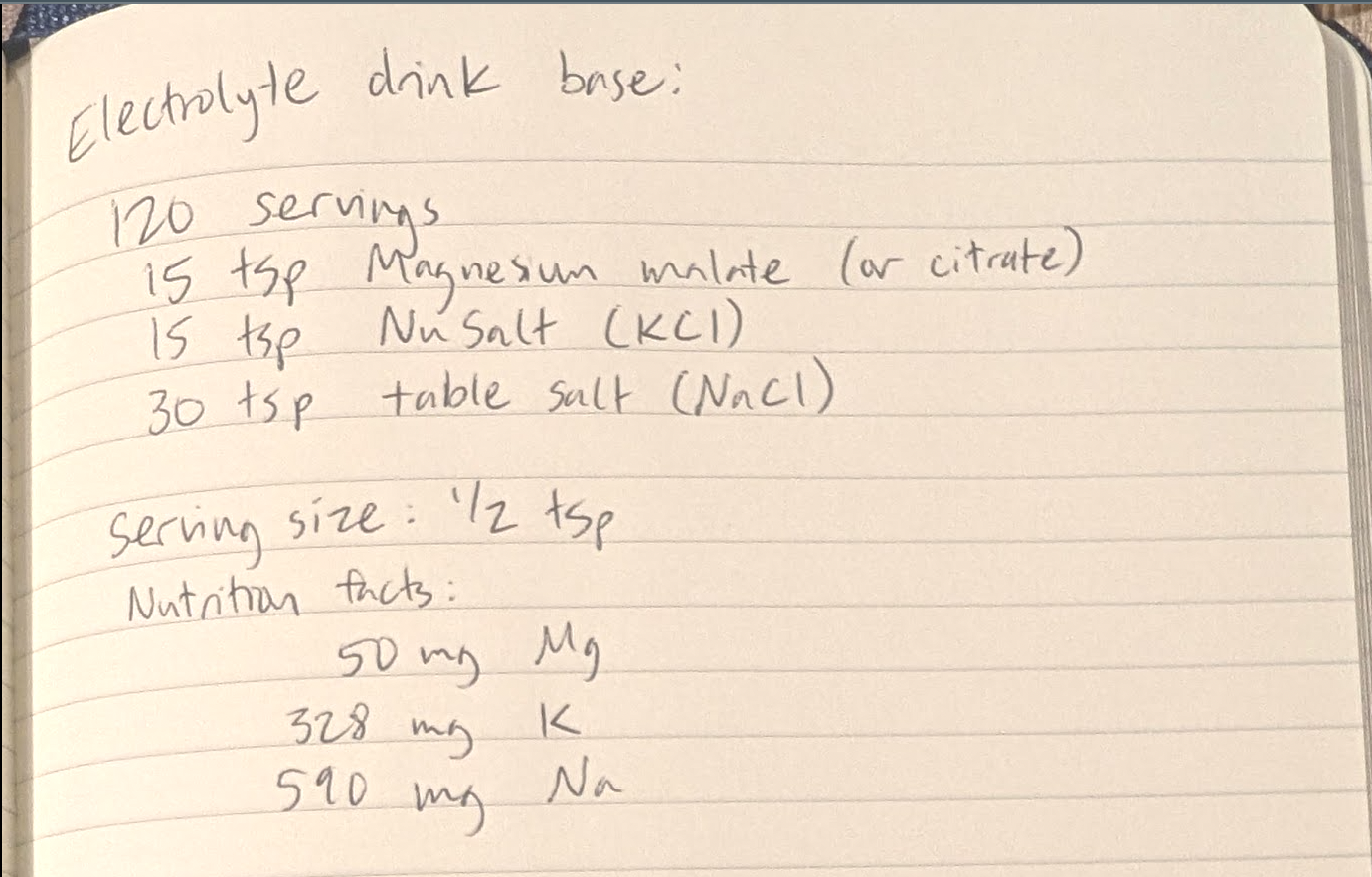
Electrolyte blend recipe
There it is in all its handwritten glory, somewhat refined over several test cycles.
Is it as flavorful as the commercial options? No. Is it as convenient? No. But it is dirt cheap, simple to make, and I feel pretty good that there aren’t ingredients in there that shouldn’t be. And it works for me.
Here it is typed out:
Electrolyte Drink Base (just the electrolytes, no flavor or sweetener yet):
Makes 120 servings
15 tsp magnesium malate (or citrate)
15 tsp nu salt (potassium chloride)
30 tsp table salt (sodium chloride)
Blend together and put in an air-tight container
Serving size 1/2 tsp
Nutrition facts:
50 mg magnesium
328 mg potassium
590 mg sodium
*I will note this is a very high concentration of these three electrolytes, but for desert activities, this is what works for me. Others may want to cut the serving size. Check with your medical provider before utilizing this level of electrolyte replacement to make sure it is approved for you.
Stevia version with flavoring:
Makes 12 servings
2 tbsp electrolyte base mix (above)
4 tbsp flavor powder (I like freeze-dried raspberry and lemon)
1/2 tbsp powdered stevia
Serving size: Approximately 1.5 tsp
If you would prefer to use sugar, omit the stevia and blend in the amount of sugar you need for the activity. One tablespoon of table sugar has 12 grams of sugar, so I’ll often use two tablespoons in a liter of water with 1/2 tsp of the electrolyte base and 1-2 tsp of the flavoring mix.
One more tip: blend these in a small food processor. The freeze-dried fruit powders tend to clump up unless they’re well blended with the electrolyte crystals.
Finally, test and refine - for you
My testing grounds for this recipe was the Whiskey Row Marathon in Prescott, AZ. It is consistently rated as one of the most difficult races in the country. This race has desert altitude, punishing elevation gains, and while there are aid stations, they’re not as frequent as a major marathon.
So I ran it largely self-supported with my tiny tupperwares of homemade electrolyte mix (sugared-up version). I finished 8th out of 16 female finishers, and here I think it is important to note that I am not by any stretch an elite athlete. As such, I felt like this was a decent test of my electrolyte mix for me.
I’ve continued using the mix over the past year in all types of settings: a Grand Canyon Rim-to-River hike, training for a thru hike of the Enchantments, a trail half marathon, and training for the NYC Marathon (in just a few days!). However, I don’t fly with my homemade mix. It’s a white powder in a little baggie and I don’t feel the need to go through additional screening for my homemade electrolyte mix.
Whether you choose to mix your own electrolytes or buy off the shelf, give them a try in a variety of activities. Find what works best for you, and continue to check in on your hydration status. Have fun out there!
